Showing posts with label rings. Show all posts

Thursday, March 27, 2014

not so large now. The rings of Uranus

Continuing from my previous post of the rings of Saturn, we'll keep going out to the last 2 planets with rings: Uranus and Neptune.

First of all, I apologize for the delayed post; I came back late yesterday and didn't have much time, and spent the rest of the day messing around with imgur and writing this: Enjoy!

Uranus's rings, unlike the inner gas giants, are very thin and dim. The ε ring, the brightest of the rings, is only a fraction of Saturns' rings brightness. Despite these obvious differences, we'll list the rings as regular from closest to Uranus to furthest.

The ζ & 1986U2R rings
The rings begin pretty much as soon as Uranus ends. The ζcc ring, the closest of the rings, is one of a couple of extensions of the ζ (Zeta) ring orbiting, in full, between 26,840 and 41,350 kilometers from the center of Uranus (~1,300-15,800 km from the surface.) Aside from being the closest, however, it isn't exactly the brightest. The ring is around 100 times fainter than the brightest ring in the system usually, but is very bright if looked at the right way (no, not like those 3D paintings). Since nearby 1986U2R's discovery in 1986, though, the ring has moved in slightly. These rings are fairly dynamic, unlike Saturn's, changing over the course of mere months or years.
An image of the 1986U2R ring showing its irregular ring arcs and ever-
changing shape. Credit: NASA
The numbered (4, 5, and 6) rings
Slightly further out from the ζ ring, we find a system of bright, narrow rings elevated slightly from Uranus's equatorial plane. These rings were designated the 6, 5, and 4 rings radiating out from the surface for lack of an appropriate Greek symbol. These rings, unlike the ζ ring, don't have much dust in them.

The α & β rings
These rings are the first of the Greek-lettered rings, but unfortunately not the last. These rings are the 2nd and 3rd brightest after the ε ring, but for some reason don't have any dust in them. They are each about half the mass of the brighter ε ring.

More Greek alphabetics: the η ring, ηc ring, and γ ring
The next few rings on our journey are all narrow and a bit dim, but that doesn't make them any less fun. The η ring is pretty dense, but the ηc ring is more broad and dim. The γ ring is much more eccentric than the other rings, and slightly wider than the η ring.

Done yet? the δc and δ rings, and why not add in the λ and ε, too?
These rings, comprising the outer parts of Uranus's thin section of the ring system, also mark the beginning of the moons. Circling just inside the λ ring is Cordelia, only about 40 km across. Despite its small size, it's still large enough to pack a bit of a punch on the ring, acting as its inner Shepard moon. Furthest out and brightest is the ε ring, also one of the largest in the system. The outer Shepard moon for this ring is Ophelia, larger than Cordelia by only 3 kilometers.

The ν ring
Not last, or least, comes the ν ring. This ring, much dimmer than the other rings, is one of two outer very dusty rings. The ring, discovered in 2003-5, is clearly bordered by the moons Portia and Rosalind (inside and outside respectively.) The ring is much larger and broader than all of the other rings closer to Uranus than it, and doesn't appear to be changing much.

Last, and least, the μ ring
The furthest of Uranus's rings, the μ ring, orbits the planet at more than twice the distance of the ε ring, and also has a few guides of its own: Puck, the largest of the inner moons, orbits on the inner part of the ring, and slightly smaller Mab orbits the ring near the center, where it's brightest. This ring, in unlike the red ν ring, is blue in color, probably made of water ice from minor collisions and/or geysers on Mab, and then slowly traveling inwards until it is picked up by Puck's gravity.


Well, that's it. Hope you enjoyed!

P.S. I made a diagram of the rings:
A diagram of Uranus's rings. Credit: Me
 Enlarged (inner halo rings):
The inner rings of Uranus Credit: Me
 Enlarged (thin, central rings):
The bright, central rings of Uranus. Credit: Me
 Enlarged (v ring and surrounding moons):
Uranus's v ring and the numerous moons around it. Credit: Me
Enlarged (μ ring):
The μ ring in all its boring glory. Credit: Me

Friday, February 28, 2014

The biggest of them all: Saturn's ring system (rings:part 2)

While Jupiter and the ice giants have small systems of rings around them, Saturn's is by far the largest. With over a thousand rings, it is also very elaborate. But only some of the rings are permanent. The main rings are designated with letters A through G, in the order discovered (not from the center of Saturn.) The rings are presented by distance from Saturn, with the main rings bolded.

The D ring:
    Width:  7,600 km
    Distance: 66,900-74,510 km
    Thickness: unknown
    Density: unknown
    Eccentricity: unknown
    Total mass: unknown
The D ring is the closest to Saturn of any of the known rings, and is fainter than any of the other main rings. This ring, unlike the others, has no distinct structure except for a series of faint, evenly-spaced ringlets. The brighter of the rings are designated D68, D72, and D73. In 1980, the rings orbited at 67,000, 72,000, and 73,000 kilometers respectively. However, later images by the Cassini space probe showed that D72 had moved 200 kilometers closer to Saturn and had grown dimmer. It's expected that the disruption was caused by a comet pushing the ring slightly out of its orbit, and it is currently reverting back into its original orbit.
The D ring, showing the evenly-spaced ringlets.
Credit: NASA/JPL/Space Science Institute
The D ring in 1980 (bottom) and 2005 (top) showing the
inward travel of the D72 ringlet (2nd from left)
Credit: NASA/JPL/Space Science Institute

The C ring:
     Width: 17,342 km
       Distance: 74,658-92,000 km
       Thickness: 5 meters
       Density: varies from 1.4 g/cm2 (inner edge) to 17 (titan ringlet)
       Eccentricity: unknown
       Total mass: 1.1 Pentillion kg.
The C ring is slightly brighter and larger than the D ring, and has more detail in it than the D ring. The main structures of it are the Colombo gap, a hole in the ring system, about 77,900 kilometers from Saturn, and, inside that gap, the Titan ringlet. These two structures are likely caused by an orbital resonance with Titan. The ringlet is slightly eccentric, with the end furthest from the Sun pointing towards Titan's location. Another, weirder gap in the rings is the Maxwell gap. This gap is about 87,500 kilometes out, and has a smaller ringlet within it. This ringlet is called the Maxwell ringlet for lack of a better name. While this ringlet has wave-like structures, implying a shepard moon orbiting near it, there has been no moon discovered to create the Maxwell gap and ringlet.
The C ring, showing the Titan gap (right) with the ringlet visible on the outer
edge of it. The Maxwell gap is visisble at the upper right corner as a dim area
outside the broad, fairly bright ring, and then a small, bright ringlet.


The B ring:
           Width: 25,500 km
           Distance: 92,000-117,580 km
           Thickness: 5-10 meters
           Density: 20-100 g/cm2
           Eccentricity: unknown
           Total mass: 28 Pentillion kg
Of all of Saturn's rings, the B ring is definitely the brightest, largest, and most massive of any of them. It  seems to have a wide range of ringlets and objects, but no apparent gaps. While most of the ring is flat, however, the outer edge of the ring also appears to be full of small moonlets up to 2.5 km across. Among other formations, the ring also appears to have small clouds of dust, called 'spokes, in it. This is confusing, because previously the rings had been believed to be created by gravity alone, but the regular appearance of the spokes doesn't seem to follow the theory. The current explanation for them is that small electric charges in them pushes them slightly away from the rest of the ring (similar to how 2 magnets will repel each other if faced the same direction against each other.) The rings also appear to be seasonal, appearing during Saturn's 'spring' and 'fall' equinoxes. While the ring doesn't appear to have any shepard moons, in 2009, while analyzing Cassini data, scientists found a moonlet about 400 meters in diameter. The moon was given the designation S/2009 S1.
The outer B ring, showing the small moonlets embedded in it.
Credit: NASA/JPL/Space Science Institute
S/2009 S1's discovery image.
Note the long shadow despite the
fairly small moon to cast it.
Credit: NASA/JPL
The Cassini Division
               Width: 4,700 km
               Distance: 117,580-122,170 km
               Thickness: 20 meters
               Density: 18-20 g/cm2
               Eccentricity: unknown
               Total mass: unknown, probably around 0.05-0.3 pentillion kg
While Saturn's B ring is the most massive, on the contrary, the Cassini Division, which is right outside it, is the most noticeable gap in the system. It is named after Giovanni Domenico Cassini, who discovered it in 1675. With only a 90x magnification, it's possible to view the gap. However, at the time, the gap appeared to be completely devoid of matter, but today's telescopes show it to have some dust inside of it, including a couple of real 'gaps'. The more notable of these is the Huygens gap, at around 117,700 kilometers out. It marks the beginning of the Cassini division, and appears to be caused by a 2:1 resonance with Mimas (it orbits twice for every orbit of Mimas.) Inside of this gap is a small ringlet called (surprise surprise) the Huygens ringlet. The smaller of these gaps is located at about 121,000 kilometers from Saturn, and is called the Laplace gap. This gap doesn't appear to have any direct cause for its formation except that it is near the outer boundary of the ring. It, unlike most other gaps, doesn't have any known ringlet within it and has no moon causing it to be there, leaving astronomers puzzled.
 
The Cassini Division is visible at the center of this image, with the Huygens
gap visible to the right, and the ringlet on the outer edge of it. The Laplace gap
is also visible near the outer edge of the division, showing the obvious lack
of a ringlet within it. Credit: NASA/JPL/Space Science Institute


The A ring:
                Width: 14,600 km
                Distance: 122,170-136,775
               Thickness: 10-30 meters
               Density: 30-40 g/cm2
               Eccentricity: unknown
              Total mass: 6.2 pentillion kg
The A ring marks the end of the popular, bright group of Saturn's rings. The ring is also the largest of the main rings. While the ring is mostly devoid of structure in the form of bright and dark rings, it still contains a few gaps and ringlets. The most notable is the Encke gap. This gap, about 133,590 kilometers from Saturn, is the closest ring to Saturn that is caused by a moon in its orbit, which was discovered in 1990. This moon, named Pan, orbits the closest of any 'moon' of Saturn (not including the moonlet S/2009 S1.) Further out, near the outer boundary of the ring, is the Keeler gap. This gap is much smaller than the Encke gap, only about 1/6th the size. This gap is caused by the moon Daphnis which is about 1/4th the size of Pan. Both of these gaps appear to have small, disturbed ringlets within them probably caused by tidal interactions with the moons in them. Other than these two main moons, hundreds of moonlets have been discovered in the ring. These are only a few hundred meters large, and are only seen from their effects on the ring around them. The most-studied of these has the unofficial name "Bleriot".
The Encke Gap is visible, showing a small ringlet with 'knots' caused by
previous gravitational interactions with Pan.
Credit: NASA/JPL/Space Science Institute


The Keeler Gap with Daphnis in it, showing 'waves' caused by its interaction
with the rings. The shadows give a general impression of height relative to
the moon itself. Credit: NASA/JPL/Space Science Institute


The Moonlet Bleriot is visible at center bottom in this image, causing
small waves in the ring around it, and a partial ring around its orbit.
Credit: NASA
The Roche Division:

           Width: 2,600 km
               Distance: 136,775-139,380 km
The Roche Division marks the 'end' to Saturn's main ring system, and is a gap of low-density material between the A and F rings. Around this distance, completely coincidentally, is the Roche Limit. This is the distance from a parent body (in this case Saturn) where a moon of a reasonable size is able to accrete from small particles. The reason the rings drop off significantly here is because most of the rings further out have accreted into small moons already. Anyways, this division is probably caused by the moon Atlas. This moon, about 40*35*19 kilometers across, orbits near the center of this division. It, along with sweeping material out of this area, also forms the F ring. Prometheus, a moon much larger than Atlas, also contributes to the Roche Division, but in an opposite way. This moon pulls material out of the F ring and into the Roche Division. This helps keep the division from being completely devoid of particles, but rather simply a low-density area. Other small moonlets also appear to contribute to it a bit, such as R/2004 S1 and R/2004 S2.
The Roche Division and Atlas are visible here, along with
the F ring and the Encke and Keeler gaps.
Credit:  NASA


The F ring:
            Width:  30-500 km
         Distance: 140,180 km
            Thickness: unknown
            Density: unknown
            Eccentricity: 0.0026
            Total mass: unknown
Just out of the main ring system orbits a small, faint ring called the F ring. It officially marks the end of Saturn's visible rings and is formed by the shepard moons, Pandora and Prometheus. The ring, despite being small, is the most dynamic ring in the system. This ring is also very irregular because Prometheus passes through the orbit of it, leaving gravitational deviations in it. The main ring seems to consist of 3 ringlets: A large, outer one that is sometimes split apart by Prometheus's gravity, a dimmer, inner one that is often straighter, and a faint once near the center that appears to be a faint 'halo'.
A straightened-out composite of the F ring, showing the extreme tidal disturbances in it. Note that the inner ring appears
to travel within the main ring about 2/3rd to the right of the image. Credit: NASA/JPL/Space Science Institute


Janus/Epimetheus ring:
               Width: 5,000 km
               Distance: 149,000-154,000 km 
While the F ring marks the end to the visible rings, there are several faint rings orbiting out of the main system. The closest of these is the Janus/Epimetheus ring. This ring, named after the moons that orbit in it, is extremely faint and is about midway between the F and G ring. The ring is probably caused by ejecta from impacts on these two moons.
Saturn's outer ring system, showing the Janus & Epimetheus ring about
midway between the F ring (bright, outer ring) and the G ring (shown)
Credit: NASA/JPL/Space Science Institute

The G ring:
               Width: 10,000-12,000 km
               Distance: 168,000-175,000 km
              Thickness: 100,000 meters (100 kilometers)
              Density: unknown
              Eccentricity: unknown
             Total mass: unknown.
The G ring is the furthest out legitimately 'bright' ring, and orbits between the F and E ring. The outer edge of the ring is only 10-20,000 kilometers away from the moon Mimas, which likely formed it. Aegaeon, another moon orbiting within the ring itself, is likely formed by the ring, and not vice versa, accreting out of the ring's faint disk.
The central G ring, with Aegaeon (bright dot) orbiting within the brightest segment. The image was taken over 10 minutes. Credit: NASA/JPL/Space Science Institute
Methone Ring arc:
                 Width: unknown, probably small.
                 Distance: 194,230 kilometers
Caused by the moon Methone, the Methone Ring arc appears to be caused by collisions with the moon Methone, which explains why it's not very bright (see image below).
Image of Methone, showing blatant, obvious lack of impact craters.
Credit: NASA/JPL-Caltech/Space Science Institute


Anthe Ring arc:
               Width: unknown
               Distance: 197,665 kilometers
The Anthe Ring arc is visible, with Anthe being the
bright 'star' near the end of it.
This ring, slightly larger than the Methone ring, was formed by impacts with the slightly-more impacted moon, Anthe. This ring, along with the moon, is in a 10:11 resonance with Mimas, leaving the ring confined to a fairly small space.
The discovery of Anthe (red square). Note how Mimas appears significantly
brighter than the rest of the moons. Credit: NASA/JPL/Space Science Institute


Pallene ring:
            Width: 2,500 km
            Distance: 211,000-213,500 km
 This ring is the largest of the lunar rings of Saturn, and is formed by the moon Pallene, which is fairly small, but has many impacts on it, forming the large ring. The ring is about as bright as the Janus/Epimetheus ring.
The moon Pallene. Credit: NASA/JPL/Space Science Institute
 The E ring:
                Width: 302,000 km
                Distamce: 181,000-483,000 km
                Thickness: 10,000,000 meters (10,000 kilometers)
                Density: very low
                Eccentricity: unknown
                Total mass: unknown
The 2nd outermost of the known rings, and the faintest of the lettered ones, the E ring is one of the dimmest and largest rings of Saturn. The ring begins near Mimas's orbit and ends at that of Rhea, making it span an enormous distance and encompassing everything further than the F ring. Most of the material of the ring seems to come from geysers on Enceladus, which later spreads out around Saturn and occasionally falls to form a blanket on other moons like Tethys, Telesto, Calypso, Helene, and Polydeuces.
The E ring, showing Enceladus's silhouette and its effects on the ring. The bright dot directly below it is a geyser
erupting near its south pole. Credit: NASA/JPL/Space Science Institute
The Phoebe Ring:
                      Width: 9,000,000 km
                      Distance: 4,000,000->13,000,000 km
                      Thickness: 2,300,000 km
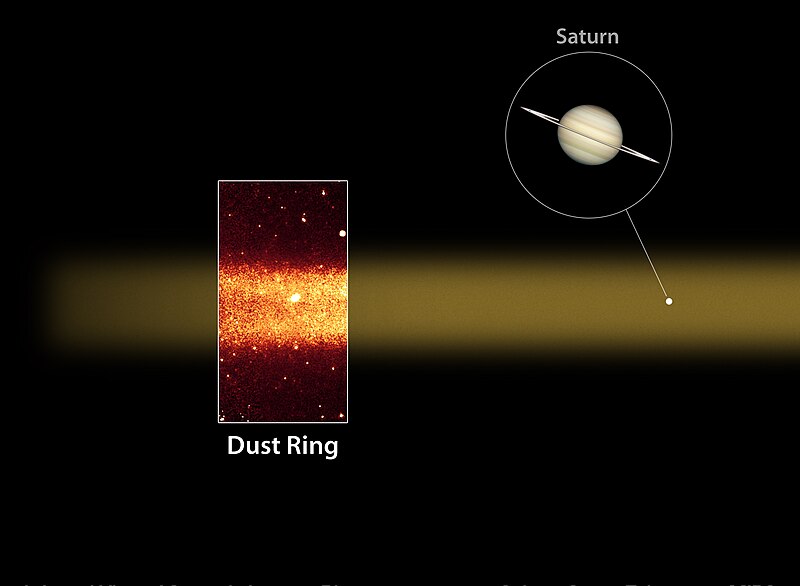
In 2009, after the Cassini and Voyager probes had finished finding new rings, scientists searching through Spitzer data found a huge ring around the orbit of Phoebe that, if visible from Earth, would be the size of 2 moons. The ring is probably formed by impacts with Phoebe, which doesn't seem unlikely considering Phoebe's extremely cratered surface. The ring, while orbiting Saturn, orbits Saturn on an angle of 27 degrees. The ring likely migrates inwards over time, eventually falling onto Saturn's outer moons, like Iapetus.
The Phoebe Ring in infrared, comparing the size of Saturn to its extent.
Credit: NASA/ESA/STScl/AURA

Image of Phoebe, showing heavily-cratered surface.
Credit: NASA/JPL/Space Science Institute

Saturday, February 22, 2014

02-22-2014 Astronomy anniversaries and new asteroids

Asteroid discoveries:

None today

Comet discoveries:

None today

Today's astronomy anniversaries:

  • Discoveries:
    • 1928 (86 years ago)- 30P/Reinmuth, a periodic comet with a period of 7.33 years, is discovered by Karl Reinmuth.
  • Events:
    • None
  • Births:
    • 1796 (218 years ago)- adolphe Quetelet, a Belgian astronomer who founded the Royal Observatory of Belgium, is born in Ghent, Belgium.
    • 1824 (190 years ago)- Pierre Janssen, a French astronomer who discovered Helium on the Sun, is born at age 0.
  • Deaths:
    • None.
           Coming up later today:
 Rings of the Solar System 2: Saturn's rings.

Friday, February 21, 2014

If you like it so much, why not put a ring on it: the rings of the Solar System, from past to future part 1

In 1610, when Galileo turned his newly-invented telescope towards saturn, he observed what appeared to be 'ears' around it. After further observations of the planet, he concluded them to be 2 satellites orbiting the planet closely. Later, in 1616, he noticed the objects to have disappeared, making him confused. While it certainly was odd, he'd accidentally found an interesting formation- a ring system. Since his initial discovery of them in 1611, and their recognition as rings in 1655, rings have been found orbiting all of the other gas giants, including Jupiter. Recent visits by spacecraft have allowed us to learn more about these objects, how they formed, what they're made of, and what will happen to them. Here are the different planets' ring systems, including past and future ones.

The inner planets:
While none of the rocky planets have rings currently, it's likely that a couple of the planets had/will have rings at some point in their life.

Earth:
Earth (obviously) doesn't have any natural satellites or rings other than the Moon (as far as we can tell), and it's likely there weren't for a fairly long time. However, Earth's violent history says otherwise. Early in Earth's formation, a planetesimal the size of Mars collided on an angle with Earth, throwing debris from both planets' crust and mantle into orbit, leaving Earth slightly smaller today than it used to be. While this material eventually coalesced into the Moon, it stayed in orbit for a few million years, long enough for it to become a ring system. The total mass of the ring system was about 15% of Earth's. After a while, half of this mass left Earth's orbit or collided with it, and the other half became 2 moons. As the Moons' gravity affected one another, they slowly 'squished' into one another, with the smaller moon forming a thicker layer of crust on the far side of the current Moon. This was probably one of the slowest collisions in the history of the Solar System.

Mars:
While it's unlikely Mars originally had a ring system, it probably will in only 50 million years. This may seem like a long time, but, for comparison, the solar system is about 4,600 millions years old. Anyways, Mars's moon, Phobos, is the only moon that orbits faster than the planet itself. Because of this, Mars is slowing down Phobos's orbit, causing it to become closer to Mars by a centimeter per year. This means that by 3000 AD, it will be 10 meters closer. Eventually, as it spirals inward from its current distance of 9234-9517 Kilometers, it will eventually pass an imaginary location called the Roche limit. This area is the location relative to a body where any orbiting object will have such great a gravitational difference that the object will be pulled apart. For Phobos, it will pass the limit when it becomes closer than 5450 kilometers away, in about 50 million years. Once this happens, the satellite will be pulled apart into a ring around Mars. This just goes to show you that nothing in the Solar System is permanent.

The outer planets:
Right now, the planets with rings currently around them in our solar system are Jupiter, Saturn, Uranus, and Neptune. Saturn's are by far the most extensive, with Uranus having loose rings, Neptune having even looser ones, and Jupiter having only a few, but fairly dense, rings, around it.

Jupiter:
Until Voyager 1 passed by Jupiter in 1979, the only known planets with rings were Saturn and Uranus.  The Voyager 1 images weren't very detailed, but later images by the Voyager 2 and Galileo probes showed the structure of the rings. These are the rings from closest to furthest from the planet:

Halo ring:
The halo ring orbits Jupiter the closest, at only about 100,000 kilometers. It's not very massive, and is the dimmest of the rings in the system, only visible in infrared. It's also the thickest, being nearly twice as thick as the second-most, the Thebe ring.
The Halo ring in infrared- the bright yellow line is the Main Ring. Credit: NASA/JPL-Caltech
Main ring:
The brightest ring in the system, the Main ring has a mass of 100,000,000,000 to 10,000,000,000,000,000 Kilograms, making it the most massive ring, too. Despite its mass, it's also the thinnest of any of the rings, only 6,500 kilometers wide. The ring appears to have a shepard moon, Adrastea. A shepard moon is a moon who, through its gravitational pull, keeps a ring bounded to an area instead of spreading out further. The only visible detail in the ring is a notch near the orbit of Metis.  Because of this apparent association, it has been named the Metis notch. Apart from this notch, the ring doesn't show much detail except a sharp decrease in brightness outside of it.
The Main ring. The faint dust visible inside is the Halo ring, and the dim-
mer part in the middle is the Metis notch. Credit: NASA/Johns Hopkins University Applied Physics Laboratory/Southwest Research Institute
Amalthea gossamer ring:
While the Halo ring and the Main ring form the main rings of the system, the Amalthea gossamer ring and the Thebe gossamer ring are very faint rings outside of it that appear to be more like haloes of material than 'rings' in the strict sense. The Amalthea gossamer ring is named after the moon Amalthea, which appears to be the shepard moon for the outer part of the ring. The ring is 53,000 kilometers wide, and 2,000 kilometers thick. It doesn't have any visible features, and is only visible at 5-10x light sensitivity.
The Gossamer rings, with the Amalthea ring's edge being visible as a slight
decrease in brightness 2/3 to the left of the image. Credit: NASA/JPL-Caltech
Thebe gossamer ring:
The faintest of the rings in the Jupiter system is the Thebe gossamer ring. Named after Thebe, it's fainter than all of the other rings, only visible at 20x light sensitivity. The ring is 97,000 kilometers wide and 8400 kilometers thick. Despite its name, however, Thebe isn't actually a shepard moon of it. The ring has been seen to continue past the moon. It's thought that the ring is formed by dust from impacts on Thebe, which are probably unusual, and therefore leaving the ring fairly not-dense.
An image of the rings of Jupiter, showing the gradual decrease in brightness further away from Jupiter.


Phewph! It seems that this ring article is taking longer than expected, so i'm going to split it into two or three parts. Tomorrow, I'll cover Saturn's ring system, and if I have time, Uranus and Neptunes. Stay tuned till then!